Required information about the program
Overview
The purpose of this program is for people in the field of safety in society who utilize a patrol dog to assist in searching for and apprehension of a suspect.
This program will contribute towards compliance with tactical-, legal-, and organizational requirements related to patrol dog handling.
Scope of the program
After completion of this program, you will be able to:
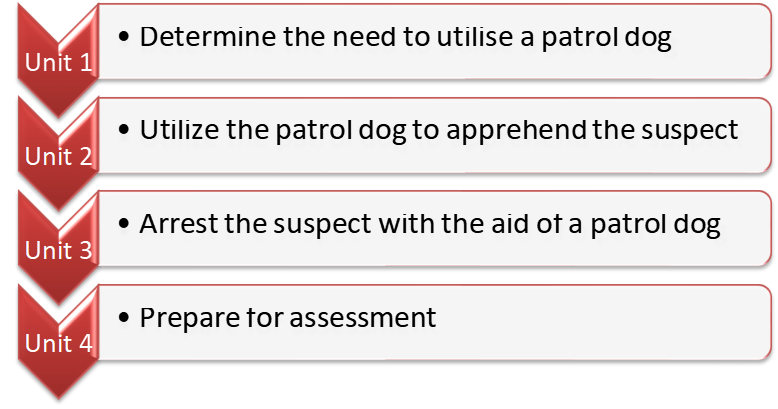
- Determine the need to utilize a patrol dog
- Utilize a patrol dog to apprehend the suspect
- Arrest the suspect with the aid of a patrol dog
Learning is assumed to be in place
- Communication NQF Level 3
- Mathematical Literacy NQF Level 3
- 243188: Care for a service dog NQF Level 3
- 243196: Supervise kennel practices
Target group
This program is for persons who, as part of their duties, are required to utilize a patrol dog to search for and apprehend a suspect.
Mode of delivery
This program will be delivered to you in a three-day facilitated workshop. The program will consist of theory lessons (30% of training) and practical exercises (70% of training). During these three days, you will be required to complete formative activities during class time, as well as after class in your own study time
|
Unit Standard Alignment |
|
|
Unit Standard Number: |
120463 |
|
NQF Level : |
4 |
|
Credits : |
15 |
Learning time
It will take the average learner approximately 150 learning hours to master the outcomes of this program. 30% of these 150 hours will be theory-based, and 70% of these 150 hours will be practical activities and exercises. Refer to your formative assessment for theory and practical activity components. These notional (learning) hours will include the time spent in the classroom, time you will use to complete your formative activities, self-study / practical application, and the time that you will use to prepare for your assessment.
Qualifications utilizing this unit standard
|
ID |
QUALIFICATION TITLE |
NEW LEVEL |
QUALITY ASSURING BODY |
|
|
Elective |
57938 |
Further Education and Training Certificate: Dog Handling |
NQF Level 04 |
SAS SETA |
|
Elective |
50102 |
National Certificate: Dog Handling |
NQF Level 05 |
SAS SETA |
Assessment
- Formative assessment will take place during the learning process in class through means of exercises. You will be required to complete activities as part of a group in class as well as individual activities. These formative activities will help prepare you for your final assessment.
- Summative assessment will be conducted at the end of this learning process through means of a Portfolio of Evidence.
The assessment criteria describe the evidence that is needed that will show that the learner has demonstrated the outcome correctly.
Kindly refer to the unit standard attached hereto for the assessment criteria of the unit standard 120463.
It is of utmost importance that the learner fully understands the assessment criteria as listed in the unit standard, as it is the only way in which the learner will know what they will be assessed against.
The final or summative assessment is the most important aspect of this training program. It is during this process that the learner will be declared competent or not yet competent.
The learner will know exactly how he will be assessed, and when and where he will be assessed. All of these details must be obtained from the training provider where the learner enrolled for their program.
Range statements
Remember: Also included in the unit standard are the range statements in support of the assessment criteria. The range statements indicate detailed requirements of the assessment criteria.
- Patrol dog may refer to a dog that has been trained to exhibit the required conditioned behavior.
The learning guide
The learner guide is included in this material under various learning units. The learner guide has been designed in such a manner that the learner is guided in a logical way through the learning material and requirements of the unit standard.
RPL assessment
The assessment of RPL learners will be conducted in the same way as for new learners. The assessment pack is exactly the same and will therefore be used for new learners as well as RPL Learners. It must, however, be noted that learners who are applying for RPL must provide proof of previous learning and subject-related experience prior to the assessment.
This proof or evidence can be in the format of certified copies (certificates) of previous learning programs that have been attended.
All the evidence will be assessed and authenticated before a learner is allowed to enroll in an RPL program.
Learning path:
- Teacher: Divine_admin Online